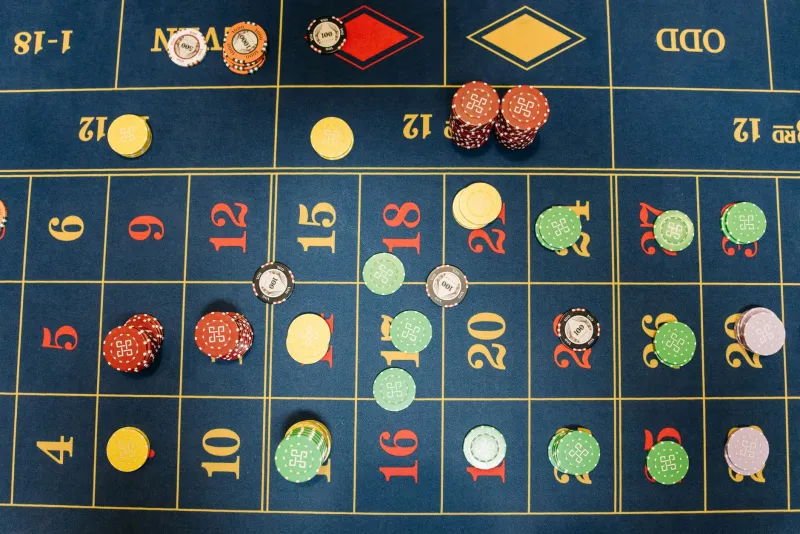
Winning Isn't the Hard Part—Stopping Is: The Real Reason Bettors Give It All Back

Here's a scenario that probably sounds familiar. You sit down for a Saturday night session—maybe it's blackjack, maybe it's a three-game NFL parlay that somehow hits—and within an hour you're up $300. You feel sharp. Lucky. Untouchable. The logical move is obvious: take the money and go grab a burger.
You don't. Two hours later, you're back to even. Maybe worse.
This isn't a story about bad luck. It's about something happening inside your head that's working against you before you ever place another chip on the table.
Your Brain on Winning: The Dopamine Problem
When you win, your brain releases dopamine—the same chemical tied to food, sex, and social approval. That rush isn't just pleasurable; it's instructional. Your brain files a note: this activity produced a reward, do it again.
The catch is that dopamine doesn't just respond to winning. It responds to anticipation of winning. The moment you cash out and walk away, that anticipatory loop goes quiet. Staying in the game keeps the loop alive. From a purely neurological standpoint, your brain is actively discouraging you from quitting, even when quitting is the smartest financial decision you could make.
Casino environments—both physical and online—are engineered to keep this loop spinning. Sound design, visual feedback, near-miss mechanics in slots, and the rhythm of live dealer interactions all serve the same function: keep the anticipatory state alive so the dopamine keeps flowing. You're not weak for falling for it. You're human.
Loss Aversion: Why Profits Feel Less Real Than Losses
Nobel Prize-winning behavioral economist Daniel Kahneman helped establish something that every serious bettor should tattoo on their forearm: losses hurt roughly twice as much as equivalent gains feel good. This is loss aversion, and it warps your decision-making in ways you probably don't notice.
When you're sitting on a $300 profit, that money doesn't fully feel like your money yet—not in the same visceral way that a $300 loss would sting. So risking it feels less scary than it should. Losing $300 of profit triggers a psychological response closer to "I broke even" than "I lost $300." That mental accounting trick makes continued play feel lower-stakes than it actually is.
Flip the scenario: if you'd lost $300 first and then clawed back to even, would you keep playing? Probably not—you'd feel relieved and want to escape before things got worse. But a $300 profit creates a cushion that feels almost disposable. That's loss aversion doing its quiet, expensive work.
The Sunk Cost Trap in Reverse
Most people understand sunk cost fallacy as the reason bettors chase losses—throwing good money after bad because they've already invested so much. But there's a mirror version that's just as dangerous when you're ahead.
Call it the momentum fallacy. You're winning, so the session feels productive. Stopping means ending something that's going well, and that feels wasteful—almost like leaving money on the table, even when you're literally holding money you've already won. The effort, the focus, the emotional energy you've put into the session creates a psychological investment that makes quitting feel like abandonment rather than smart decision-making.
Experienced players aren't immune to this. Plenty of sharp sports bettors have had winning weeks unravel because a profitable Thursday had them feeling invincible by Sunday night.
Real Scenarios Where the Exit Mattered
The $500 Flip: A casual player in Vegas hits a hot run at the $25 blackjack table, turning a $200 buy-in into $500 over about 40 minutes. Instead of cashing out, they set a mental target of $800. The table goes cold. They leave down $50. The entire profitable session became a losing one because the exit target was arbitrary and emotionally motivated rather than pre-planned.
The Parlay Snowball: A bettor hits a four-leg Saturday college football parlay for $400. Rather than pocketing the win, they roll $200 of it into a Sunday parlay "to let it ride." The Sunday parlay loses. Then they chase with a Monday Night Football bet to get back to their high point. By Tuesday they've turned a $400 win into a $180 net loss.
The Slot Session: An online player deposits $100 and runs it up to $340 over an hour of play. They tell themselves they'll quit at $400. They never hit $400. They quit at $60, frustrated rather than grateful for the profit that was right there to take.
In every case, the problem wasn't skill or luck. It was the absence of a pre-committed exit plan.
Building an Exit Strategy That Actually Works
The solution isn't willpower—it's structure. Willpower is a finite resource, and it depletes exactly when you need it most: in the middle of a hot session when everything feels possible. Here's how to build exits that hold up under pressure.
Set your win target before you start, not during. Decide on a specific dollar amount or percentage gain that triggers a mandatory stop. Write it down. Tell someone. Make it real before the dopamine kicks in and turns you into an optimist.
Use the half-and-bank rule. When you hit a significant profit milestone, immediately withdraw or set aside at least half of your winnings into a mental (or literal) "locked" category. You can keep playing with the remainder, but you've guaranteed yourself a winning session no matter what happens next.
Time limits work better than dollar limits for some players. If tracking profit in the moment feels abstract, set a hard time limit instead. When the timer goes off, the session ends—regardless of where you are. This removes the emotional negotiation entirely.
Recognize the "one more" warning sign. The phrase "just one more" is one of the most expensive sentences in gambling. The moment you catch yourself thinking it, treat it as a stop signal rather than a green light. One more bet, one more hand, one more spin is almost never actually one more.
Pre-schedule your cash-out. Some online platforms let you set automatic withdrawal triggers or cooling-off periods. Use them. Removing the decision from the heat of the moment is always the smarter play.
The Real Edge
At VNI9Bet, we talk a lot about playing bold and betting smart. Those two things aren't in conflict—but they do require different skills. Playing bold means having the confidence to act on good spots. Betting smart means having the discipline to protect what you've earned.
The sharpest bettors aren't the ones who run every session to zero trying to maximize. They're the ones who understand that a realized profit is the only kind that counts. Money you've won but given back isn't a near-miss—it's a loss with extra steps.
Walking away while you're ahead isn't quitting. It's the whole point.